
Quick Answer:
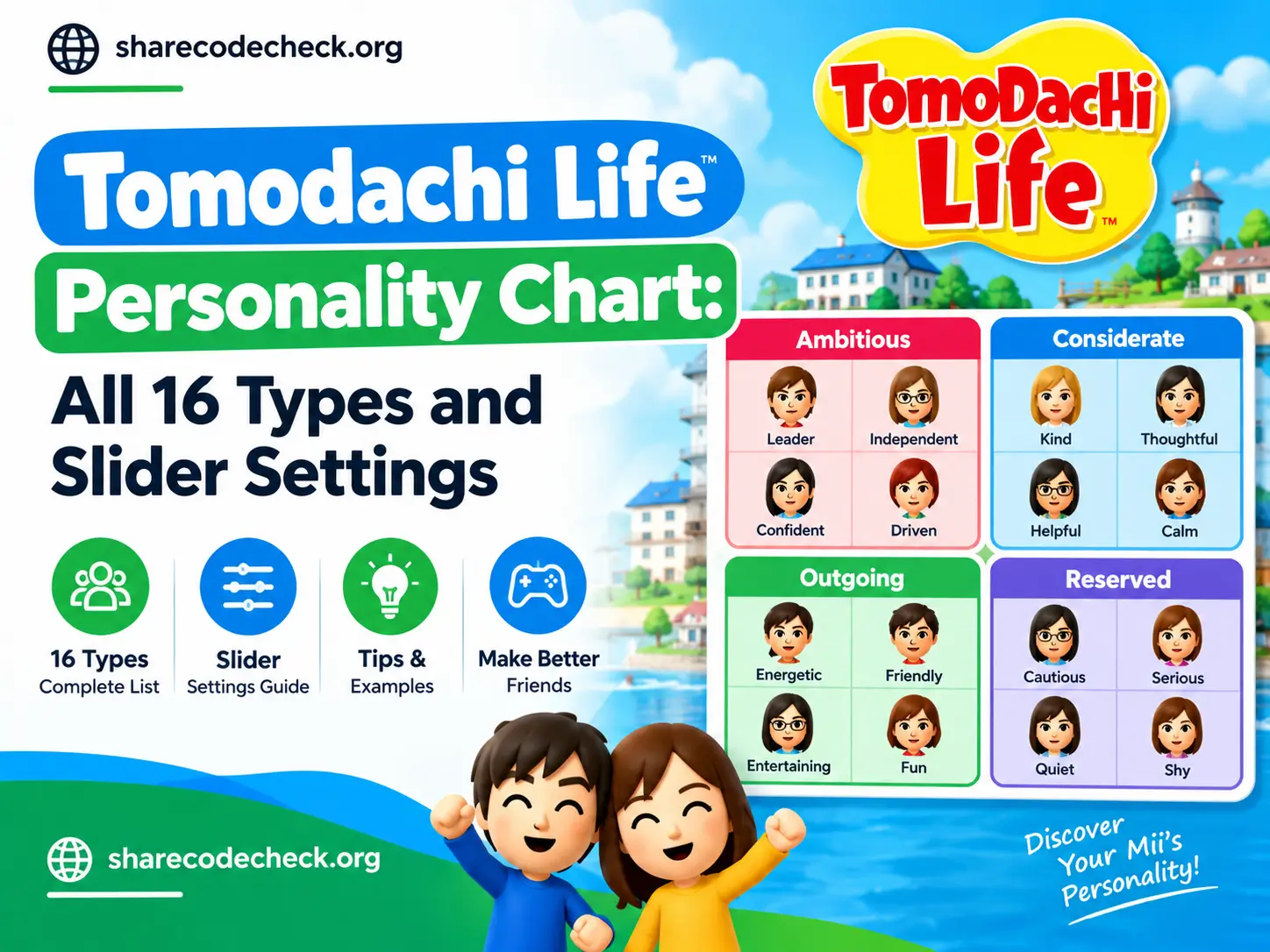
Tomodachi Life: Living the Dream has 16 personalities in four groups, set by four sliders: Movement, Speech, Energy, and Thinking. The Overall slider doesn’t change the result.
The Tomodachi Life personality chart for Living the Dream lists 16 personalities across four colour-coded groups. You pick one by setting four sliders on the Mii creation screen. The tables below give each type’s US and UK names and a slider recipe to copy.
By Muhammad Rehan Iqbal, Founder and Developer of ShareCodeCheck.org. This guide compiles figures published by games press and community testers. The author did not run independent slider tests.
How the Tomodachi Life personality chart is organised?
Every Mii falls into one of four groups, and each group holds four personalities. The group decides the colour of a Mii’s house, according to Nintendo Life’s personality guide.
| Group (US / UK-EU name) | Colour | Typical feel | Personalities (US / UK-EU) |
|---|---|---|---|
| Ambitious / Confident | Blue | Straight talkers who like things done correctly | Achiever / Busy Bee; Maverick / Headstrong; Rogue / Individualist; Visionary / Leader |
| Considerate / Easy-Going | Yellow | Friendly, dreamy, friends come first | Sweetie / Softie; Cheerleader / Optimist; Buddy / Carer; Daydreamer / Dreamer |
| Outgoing / Energetic | Red | Always busy and passionate | Merrymaker / Bubbly; Charmer; Dynamo / Hot-Blooded; Go-Getter / Adventurer |
| Reserved | Green | Calm, cautious, thoughtful | Observer / Introvert; Perfectionist; Thinker; Strategist / Patient |
Nintendo Life lists Maverick as “Maverick / Individualist”, but Destructoid and Pocket Tactics both use “Headstrong” for the UK name. “Individualist” is the UK name for Rogue, so the Nintendo Life heading is probably a typo.
How to set each personality with the sliders?
Four sliders decide the result. Each runs from 1 to 8:
- Movement: Slow to Quick
- Speech: Polite to Honest
- Energy: Flat to Varied
- Thinking: Serious to Chill
A fifth slider, Overall (Normal to Quirky), has no effect on the personality. Use the starting values below, and treat them as a recipe. Nintendo Life notes that small variations still land on the same type.
| Personality (US / UK-EU) | Movement | Speech | Energy | Thinking |
|---|---|---|---|---|
| Achiever / Busy Bee | 1 | 8 | 7 | 2 |
| Maverick / Headstrong | 8 | 6 | 2 | 2 |
| Rogue / Individualist | 4 | 8 | 1 | 2 |
| Visionary / Leader | 8 | 8 | 8 | 1 |
| Sweetie / Softie | 2 | 1 | 7 | 7 |
| Cheerleader / Optimist | 8 | 1 | 6 | 7 |
| Buddy / Carer | 1 | 2 | 6 | 6 |
| Daydreamer / Dreamer | 5 | 4 | 5 | 5 |
| Merrymaker / Bubbly | 6 | 6 | 6 | 6 |
| Charmer | 3 | 7 | 7 | 7 |
| Dynamo / Hot-Blooded | 8 | 8 | 1 | 8 |
| Go-Getter / Adventurer | 8 | 6 | 7 | 6 |
| Observer / Introvert | 1 | 1 | 1 | 4 |
| Perfectionist | 4 | 4 | 5 | 4 |
| Thinker | 6 | 3 | 1 | 1 |
| Strategist / Patient | 1 | 1 | 8 | 1 |
Values are drawn from Destructoid’s chart and cross-checked for direction against Pocket Tactics. Both sources agree on which end of each slider every type sits at.
Why other charts use different names?
The US and UK/EU releases use different names, but the personalities behave the same. Destructoid states that only the labels differ. A chart that says “Hot-Blooded” and one that says “Dynamo” describe the same type, so match by group colour and slider pattern rather than by name.
How to change a Mii’s personality later?
You can change a personality at any time. Select the Mii, open its Edit Mii or profile screen, choose the personality box, reset the sliders and confirm. Guides describe slightly different menu paths, so follow the on-screen labels in your version.
Does personality affect compatibility?
Sources disagree, so treat any firm claim with caution. Several guides, including Game8’s relationships guide, say that similar personalities are more likely to become friends and that dissimilar ones may struggle. They also note that individual quirks can cause friction even between two Miis of the same type.
Nintendo Life’s guide takes a narrower view. It says that, so far, personality appears to affect only how Miis react and behave, and the colour of their home. The in-game Compatibility Tester is a separate feature. In the 3DS game it used birthdays, and MiiWiki says the game described its results as “just for fun”. I couldn’t confirm the same rules for Living the Dream.
Does the game use MBTI?
No official MBTI mapping exists. The game’s personality system is its own design, built on the four sliders above. Fan-made MBTI conversions circulate, but none has been confirmed by Nintendo, so this guide doesn’t publish one.
Key Takeaways
- There are 16 personalities in four groups, and each group has its own colour.
- Four sliders decide the type: Movement, Speech, Energy and Thinking. Overall is cosmetic.
- US and UK names differ, but the types are identical.
- Personality can be changed whenever you like.
- Claims about compatibility and romance are unconfirmed, and sources disagree.
Next step: Pick one Mii, set its sliders to a recipe above, then check that the home colour matches the group you intended.
FAQs
How many personalities are in Tomodachi Life: Living the Dream?
There are 16, split into four groups of four. The groups are Ambitious/Confident, Considerate/Easy-Going, Outgoing/Energetic and Reserved.
Is there a Tomodachi Life 2 personality chart?
There is no game officially titled “Tomodachi Life 2”. People searching that phrase usually mean Tomodachi Life: Living the Dream, the 2026 Switch follow-up to the 3DS game. Nintendo Life reports that its personality types appear to match the 3DS ones, so the chart above applies to both.
Do the US and UK personality names mean different things?
No. The names differ by region but the types and effects are the same. Use the paired names in the chart above to match any guide you find.
Does the Overall slider change a personality?
No. It affects how quirky a Mii is, but it has no effect on which of the 16 types the Mii receives.
Can two Miis with the same personality still dislike each other?
Yes. Community guides report that individual quirks can cause friction even between Miis of the same type, so a matching personality doesn’t guarantee friendship.
Which personalities are best for romance?
No verified source ranks personalities for romance. Some guides suggest similar types bond more easily, but Nintendo Life attributes only behaviour and house colour to personality. Compatibility advice is best treated as community observation.
Can I change a personality after creating a Mii?
Yes, at any time. Reopen the Mii’s edit screen, adjust the sliders and confirm.