Quick Answer
A right to rent check confirms a prospective tenant is legally allowed to rent residential property in England. Non-British and non-Irish tenants with digital immigration status usually prove this with a right to rent share code, generated on GOV.UK and valid for 90 days. Landlords and letting agents verify the code using the official Home Office online service before the tenancy begins.
This Guide Is For
- Tenants and prospective renters with digital immigration status
- Landlords carrying out checks before a tenancy starts
- Letting agents managing compliance on behalf of landlords
- Anyone confused about what a right to rent share code is for
What Is a Right to Rent Check?
Right to rent is a legal requirement in England:
Landlords must check that a prospective adult tenant is not disqualified from renting due to their immigration status, before the tenancy starts. A correctly completed check gives the landlord a statutory excuse — protection against a civil penalty if the tenant’s status later turns out to be invalid.
The Tenant Perspective
British and Irish citizens usually prove their right to rent with a passport or birth certificate plus other official documents — no share code needed.
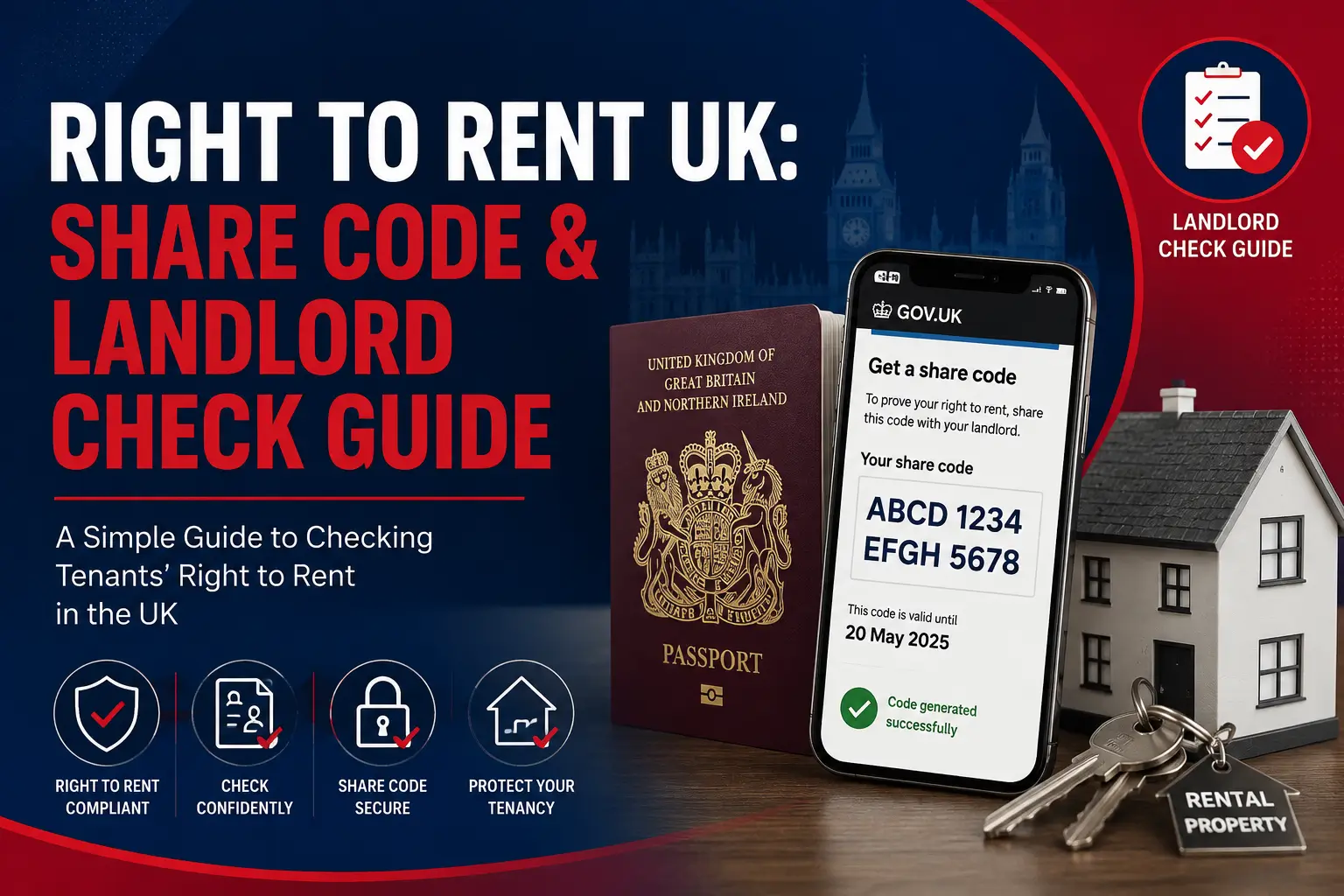
Tenants with digital immigration status — an eVisa, settled or pre-settled status under the EU Settlement Scheme, or status confirmed via the “UK Immigration: ID Check” app — generate a right to rent share code:
- Sign in to your UKVI account on GOV.UK.
- Select “prove your right to rent” as the reason for the code.
- Receive a 9-character code, which begins with the letter R.
- Give the code and your date of birth to your landlord or letting agent.
The code is free and valid for 90 days. Because the clock starts the moment it’s generated, it’s best to create the code close to when it’s actually needed rather than weeks in advance.
The Landlord Perspective
Landlords or letting agents should:
- Ask the tenant for their right to rent share code and date of birth.
- Enter both details into the official GOV.UK right to rent checking service — free, no account needed.
- View the live result: whether the tenant has permission to rent, and whether that permission is time-limited or unlimited.
- Keep a record of the check, including the date it was carried out, to preserve the statutory excuse.
A landlord cannot insist on a share code from someone who is legally entitled to rely on documents instead — doing so risks unlawful discrimination.
Equally, refusing a valid share code because paper documents are preferred undermines compliance.
What the Check Confirms?
The result shows whether the tenant is permitted to rent and, if the permission is time-limited, when it expires. If permission is time-limited, landlords are generally expected to follow up with a further check before or around that expiry date to maintain their statutory excuse.
Common Mistakes
- Accepting a code generated for the wrong purpose — a right to work code (starting with W) will not return a result on the right to rent service
- Details not matching (name spelling, name order, or date of birth mismatches)
- Letting a share code sit unused for weeks until it expires
- Not keeping a dated record of the check
- Treating some tenants differently based on nationality or appearance, which risks discrimination
If a tenant genuinely cannot prove their status online — for example, they have an outstanding application or appeal — landlords can use the Home Office Landlord Checking Service to request a decision rather than refusing the tenancy outright.
Employer Responsibilities vs Landlord Responsibilities
| Employer (Right to Work) | Landlord (Right to Rent) | |
|---|---|---|
| Legal duty | Check before employment starts | Check before tenancy starts |
| Accepted share code prefix | W | R |
| Checking service | GOV.UK employer right to work service | GOV.UK landlord right to rent service |
| Penalty for non-compliance | Civil penalty per illegal worker | Civil penalty per lodger/occupier |
| Applies to | England, Scotland, Wales, NI | England only |
Practical Scenario
Example Case (hypothetical):
Priya, who holds pre-settled status, applies to rent a flat in Manchester. The letting agent asks for proof of her right to rent. Priya signs in to her UKVI account, selects “right to rent” as the reason, and receives a share code starting with R.
She sends the code and her date of birth to the agent, who checks it on the official GOV.UK service, confirms Priya’s permission is unlimited, saves the result, and proceeds with the tenancy agreement.
Key Takeaways
- A right to rent check confirms a tenant’s legal permission to rent property in England and protects landlords with a statutory excuse.
- Tenants with digital status generate a right to rent share code, which begins with the letter R.
- Share code checks are free, last 90 days, and should be generated close to when they’re needed.
- Right to rent applies only in England, unlike right to work checks.
- A right to work share code cannot be used for a right to rent check, and vice versa.
- Landlords should keep dated records of every check to maintain compliance.
FAQs
Do all tenants need a right to rent share code?
No. Only non-British, non-Irish tenants with digital immigration status typically need one. British and Irish citizens usually use documents instead.
How long is a right to rent share code valid?
90 days from the date it’s generated, and it can be reused during that period if needed.
Can a landlord use a right to work share code to check right to rent?
No. Codes are purpose-specific. A right to work code (starting with W) will not return a result on the right to rent service.
Does right to rent apply across the whole UK?
No. Right to rent checks are a legal requirement in England only.
What if my share code has expired before my landlord checks it?
You’ll need to generate a new one through your UKVI account and send the updated code.
Can a landlord refuse me because I gave documents instead of a share code?
Not automatically — if you’re legally entitled to rely on documents, a landlord should accept them rather than requiring a share code.
What happens if a landlord doesn’t carry out a right to rent check?
They risk losing their statutory excuse and may face a civil penalty if the tenant turns out not to have the right to rent.
1 thought on “Right to Rent UK: Share Code & Landlord Check Guide”