Quick Answer
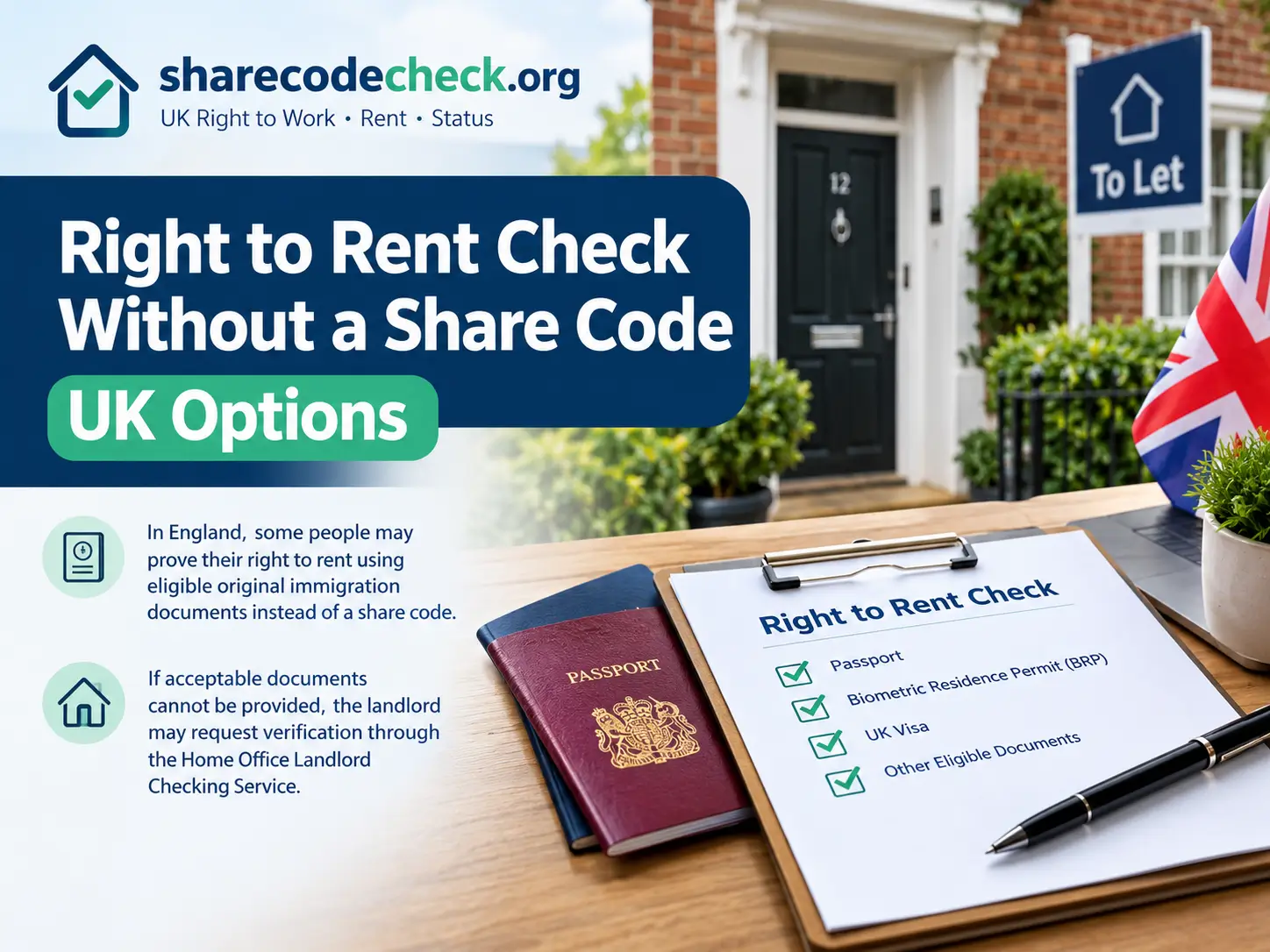
Without a share code, landlords can do a manual document check, use a certified IDSP (British and Irish passports), or ask the Landlord Checking Service.
Who this guide is for:
This guide is for landlords and letting agents in England whose prospective tenant has no share code.It goes deeper on the routes that do not use a share code. For the share code route, read our right to rent share code guide.
Why some tenants have no share code?
A share code comes from the Home Office service for people with a digital immigration status. British and Irish citizens do not have one. The online service is not available for UK passport holders.
Other tenants may hold an accepted document that proves their right to rent, so the landlord can check it directly. Right to rent checks apply in England only.
Which route fits which tenant?
| Tenant situation | Route that applies |
|---|---|
| British or Irish citizen with a passport | Manual check of the original passport, or a check through a certified IDSP |
| Tenant with an accepted List A document (unlimited right to rent) | Manual check of the original document |
| Tenant with an accepted List B document (time-limited right to rent) | Manual check of the original document |
| Tenant with digital status (such as an eVisa) | Home Office online check, which needs a share code |
| Tenant who cannot show acceptable evidence, for example a pending application or documents held by the Home Office | Landlord Checking Service |
The Home Office publishes the acceptable documents. Use the current List A and List B in its landlord’s guide, not an old copy.
Check every adult, not just some
The duty covers adults aged 18 and over who will live in the property. Check every adult occupier in the same way, whether or not they are named on the tenancy agreement.
Checking only some people, or checking people differently because of their nationality or how they look, risks unlawful discrimination.
Route 1: Manual document check
A manual check uses original documents from the Home Office lists.
The Home Office describes three steps: obtain the original document, check it in the tenant’s presence, then copy and record it. When you check, confirm that the documents look genuine and have not been tampered with. Confirm the photo matches the tenant and that any permission to stay has not expired.
Make a clear copy of each document in a format that cannot be altered later. Store it securely, electronically or on paper.
Record the date you carried out the check. Writing a date on the copy is not enough by itself to show when you did the check, so record it as the date of the check. Keep the copies for at least one year after the tenancy ends. Then destroy them securely, because they are personal data.
Route 2: Certified IDSP check
An IDSP is a certified identity service provider. It verifies a passport digitally, so a face-to-face meeting is not needed.
This route is for British and Irish citizens with a valid passport. It does not cover tenants who must use the online share code check. Use only a provider on the Home Office list of certified providers.
You are still responsible for checking that the image in the digital copy is of the tenant. Keep the output the provider gives you, and keep copies for at least one year after the tenancy ends.
Can you insist on a share code or an IDSP?
No. A landlord cannot insist on a share code from someone who is entitled to rely on documents. Using an IDSP is optional. A manual check remains available for British and Irish citizens. Treating people less favourably because they prefer documents risks unlawful discrimination.
Route 3: Landlord Checking Service
The Landlord Checking Service is for tenants who cannot show any acceptable evidence.
This includes someone who has applied for leave to remain and is waiting for a decision, or whose documents are held by the Home Office. If the Home Office confirms the person has a right to rent, it issues a positive notice. Keep it with the date of the check. Do not refuse a tenancy just because there is no share code and no documents. Check which route applies first.
What about a tenant with an eVisa but no code?
A tenant with digital status through an eVisa can prove their right to rent only through the Home Office online service. So a manual check cannot replace the share code for them. The tenant generates a code in their own UKVI account, and you check it on the official landlord service.
If their account is not working, point them to our immigration status guide, which covers reporting eVisa errors.
Time-limited right to rent!
Some documents show a right to rent that ends on a date. Check the current Home Office landlord’s guide to see whether and when a follow-up check is needed for your tenancy. Keep a note of the expiry date with your records either way.
Common mistakes to Avoid!
- Treating British or Irish citizens as exempt from a check.
- Accepting a scan or photo instead of the original document.
- Checking some adult occupiers but not others.
- Writing a date on a copy without recording that it is the date of the check.
- Keeping copies indefinitely instead of destroying them after the retention period.
- Insisting on a share code from someone who can use documents.
Key Takeaways
- No share code does not mean no check. Every adult occupier needs a right to rent check in England.
- Three routes work without a share code: manual document check, certified IDSP and Landlord Checking Service.
- Manual checks need original documents in the tenant’s presence, with a dated copy.
- IDSP checks cover British and Irish passport holders and are optional.
- A tenant with an eVisa must use the online service, which needs a share code.
- Keep copies for at least one year after the tenancy ends, then destroy them securely.
FAQs
Does a British citizen need a share code for right to rent?
No. The online service is not available for UK passport holders. Use a manual check of the original passport or a certified IDSP.
Can I accept a photo of a passport?
For a manual check you need the original document in the tenant’s presence. A scan or photo is not enough.
What if the tenant has no documents at all?
If they cannot show any acceptable evidence, ask the Landlord Checking Service rather than refusing the tenancy.
Do I need to check everyone who lives there?
Yes, every adult occupier aged 18 or over, whether or not they are named on the agreement.
How long must I keep the records?
Official guidance says to keep copies for at least one year after the tenancy ends, then destroy them securely. Confirm this in the current landlord’s guide.
Does right to rent apply in Scotland, Wales or Northern Ireland?
No. Right to rent checks are a legal requirement in England only.