Quick Answer:
A share code is a temporary nine-digit code issued by the UK Home Office.It lets a person with an eVisa or other digital immigration status prove it online.It does not require a physical document.It is generated through the GOV.UK “View and prove your immigration status” service. You give it to an employer, landlord, or letting agent. They enter it on a separate GOV.UK checking service. They also enter the holder’s date of birth. This confirms the right to work, right to rent, or other status. Share codes are time-limited, and each one is normally tied to one specific type of check.
This Guide For:
This guide is written for UK employers, landlords, and visa/immigration status holders encountering a share code request for the first time.
What is Share Code?
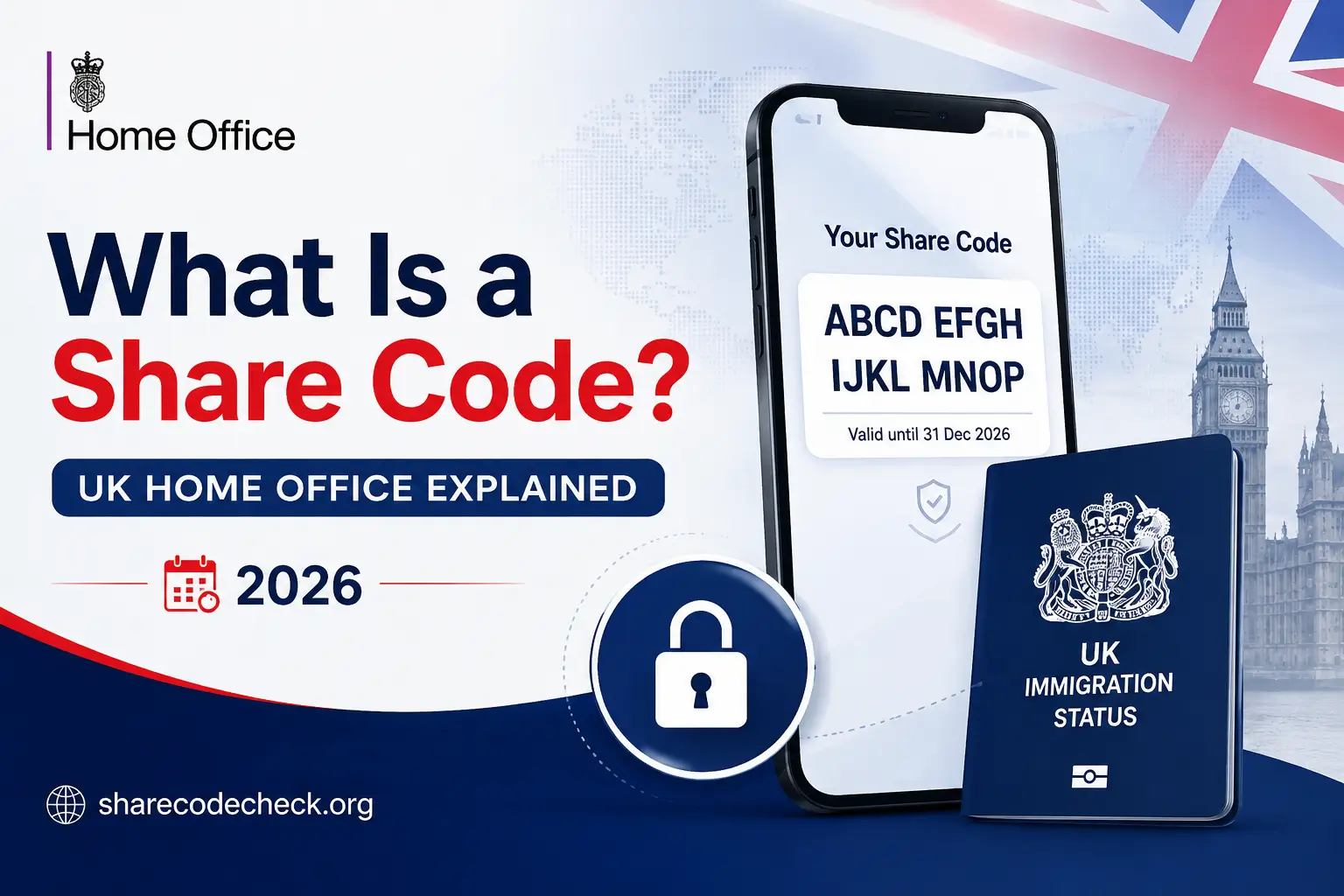
A share code is a short code — nine letters and numbers — that proves someone’s UK immigration status online instead of with a paper document. The UK Home Office issues it through GOV.UK, and the person receiving it, such as an employer or landlord, uses it on a separate government page to confirm the holder’s status.
What Does a Share Code Actually Do?
A share code exists to replace a physical document as proof of immigration status. Before the UK’s shift to digital-only records, someone might have shown a Biometric Residence Permit (BRP) — a physical, card-based ID document previously issued to non-British, non-Irish residents — as proof they could legally live, work, or rent in the UK.
The Home Office confirmed it phased out reliance on physical BRPs in favour of digital eVisas (a person’s immigration status record stored online rather than on a card) by the end of 2024, according to GOV.UK. Since then, a share code is effectively the “key” that unlocks a look at someone’s digital status without giving the checker direct access to the holder’s full Home Office account.
Who Needs a Share Code?
Three groups typically deal with share codes, and each has a slightly different reason:
- Visa and immigration status holders — including EU Settlement Scheme (EUSS) members (EU, EEA, and Swiss citizens granted settled or pre-settled status after living in the UK before the relevant Brexit cut-off dates) and other non-British/Irish nationals with an eVisa — generate a share code to prove their status to someone else.
- Employers — who are legally required to run a right to work check (the check confirming a new or existing employee is legally permitted to work in the UK) before or during employment.
- Landlords and letting agents — who are legally required to run a right to rent check before letting a property to someone who isn’t a British or Irish citizen.
How to Get a Share Code?
Generating a share code takes place entirely on GOV.UK, not through a third-party site:
- The status holder signs in to their UKVI account (the online account tied to their eVisa).
- They select the reason for sharing — for example, “prove right to work” or “prove right to rent.”
- GOV.UK generates a unique code, valid only for that stated purpose.
- The holder shares the code (and their date of birth) directly with the employer, landlord, or organisation requesting it — by text, email, or reading it out.
Typical scenario:
A tenant applying for a flat is asked by the letting agent for “a share code and your date of birth” before the tenancy agreement is signed. The tenant logs into their UKVI account, generates a right-to-rent-specific code, and sends both pieces of information to the agent, who then runs the check independently on GOV.UK.
This is the general pattern most first-time users report — not a documented individual case, but how the process is designed to work end to end.
What Does a Share Code Look Like?
A share code is nine characters, a mix of letters and numbers, usually displayed in a grouped format (for example, similar to W1L 2AB style spacing) to make it easier to read and share accurately. It’s case-sensitive on some checking pages, so it should always be copied exactly as shown rather than retyped from memory.
How Long Is a Share Code Valid For?
Share codes are deliberately time-limited rather than permanent, and the exact window depends on the type of check it was generated for. GOV.UK guidance has historically stated different validity periods for right-to-work versus right-to-rent style checks.
This is a detail that changes with Home Office policy updates, so always confirm the exact expiry date shown at the moment the code is generated or checked, rather than relying on a fixed number from an older article. Once expired, the code stops working entirely and a new one must be generated.
Share Code vs. Physical Document (BRP): What Changed
| Feature | Share Code (Digital, current) | BRP (Physical, phased out) |
|---|---|---|
| Format |
9-character alphanumeric code |
Plastic ID card |
| Where it’s checked | Online, via a GOV.UK checking service | Visually, by inspecting the card |
| Expiry | Short, purpose-specific window | Fixed expiry date printed on card |
| Risk of loss/forgery | Low — tied to online account, not a physical object | Higher — cards could be lost, damaged, or forged |
| Current status | Standard method since the 2024 shift to eVisas | No longer issued for new applications |
How Employers and Landlords Check a Share Code?
The employer or landlord doesn’t use the same page the status holder used to generate the code. They go to the separate GOV.UK checking service for their specific purpose — “check a right to work” or “check a right to rent” — and enter the share code plus the holder’s date of birth.
GOV.UK then returns a result confirming the person’s status and what it permits (for example, permission to work, and for how long).
What Happens If a Share Code Doesn’t Work?
A share code can fail to return a valid result for a few specific reasons: it has expired, it was typed incorrectly, it was generated for the wrong type of check (a right-to-rent code won’t work on a right-to-work check page), or the date of birth entered doesn’t match Home Office records exactly.
In any of these cases, the fix is generating a fresh, correctly-purposed code rather than resubmitting the same one.
Is a Share Code Still Relevant in 2026?
Yes — since the Home Office completed its move away from physical BRPs, the share code (alongside the eVisa system it’s built on) is now the standard method for proving immigration status in the UK, not a temporary workaround. Anyone still holding an old physical document should expect to be asked for a share code instead going forward.
Key Takeaways
- A share code is a temporary, nine-character alphanumeric code issued by the UK Home Office to prove someone’s digital immigration status online.
- It’s generated by the status holder through their GOV.UK/UKVI account and given to whoever needs to check their status, along with their date of birth.
- Employers use it for right to work checks; landlords and letting agents use it for right to rent checks — each code is tied to a specific check type.
- Share codes expire after a limited period, and an expired or mismatched code will fail the check, requiring a new one.
- Share codes replaced physical Biometric Residence Permits (BRPs) as the UK’s standard proof-of-status method following the 2024 shift to digital eVisas.
- The checker (employer/landlord) and the holder use two different GOV.UK pages — one to generate, one to verify — not the same page.
FAQs
Is a share code the same as a National Insurance number?
No. A share code proves immigration status; a National Insurance number is a separate tax and benefits reference number. Confusing the two is a common misconception among first-time applicants, since both are requested around the same time during onboarding or tenancy setup.
Is a share code still worth using in 2026, or has it been replaced by something else?
Yes — it remains the current, standard method for proving UK immigration status now that physical BRPs have been phased out. There is no newer replacement system as of this writing.
How is a share code different from just showing a passport?
A passport alone doesn’t confirm immigration status or work/rent permissions in the UK for non-British/Irish nationals — a share code specifically confirms what the Home Office has on record for that person’s status, which a passport by itself doesn’t show.
Does it cost anything to generate a share code?
No — generating a share code through the GOV.UK “View and prove your immigration status” service is free. There’s no legitimate reason a third party should charge someone to generate their own code.
Why does my share code keep saying “invalid” even though I just generated it?
This is a frequently reported issue in community discussions, usually caused by one of three things: the code was generated for the wrong check type, the date of birth was entered slightly differently than Home Office records show, or there’s a short delay before a newly generated code becomes active on the checking system.