Quick Answer:
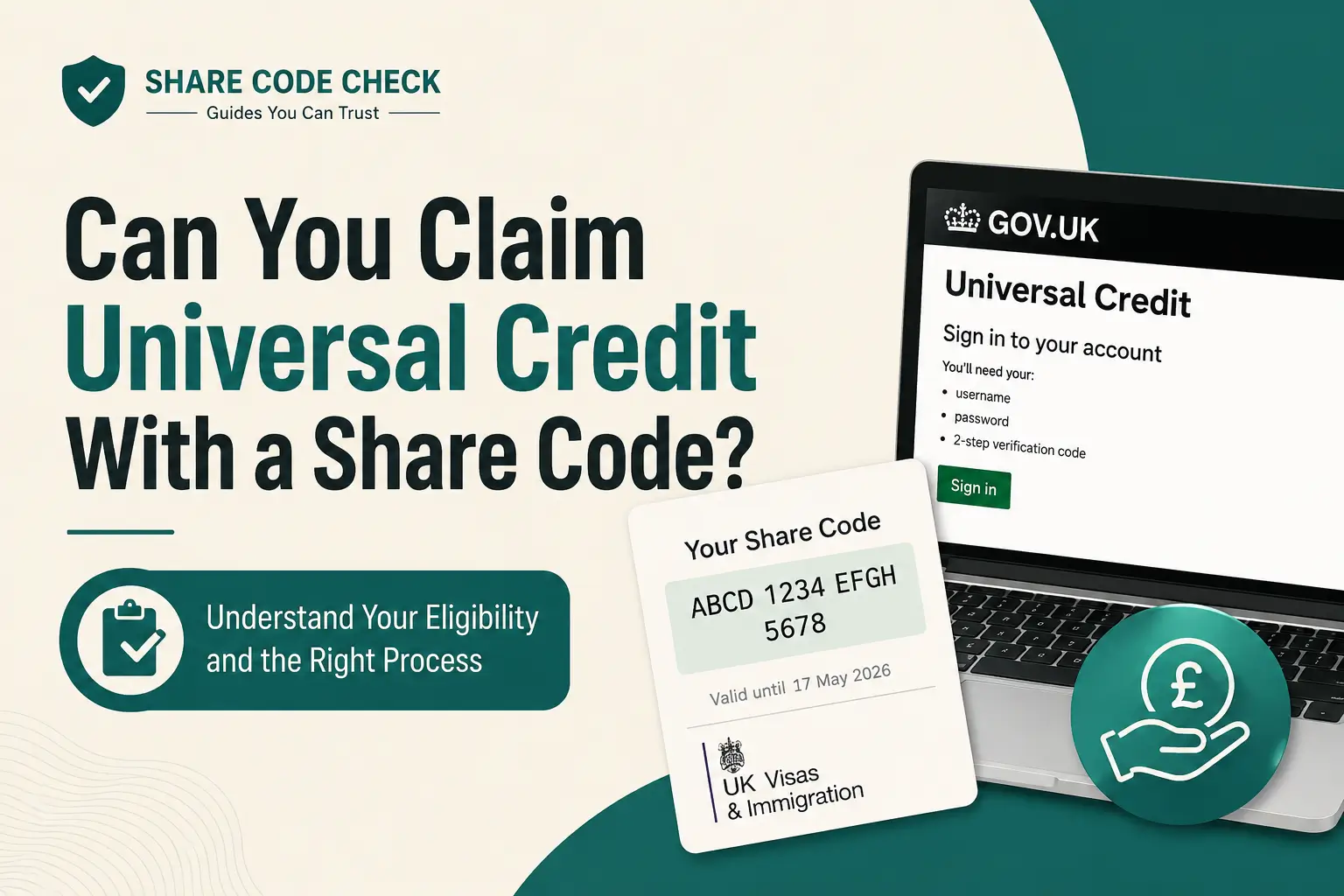
Your share code shows your immigration status, not Universal Credit eligibility. No recourse to public funds blocks a claim; settled status usually clears it. Applies to UK visa and EUSS holders.
The Short Answer
Your share code doesn’t grant or block Universal Credit. It only proves the immigration status behind the decision.
Who Makes the Decision?
The Department for Work and Pensions (DWP) decides eligibility by reading your status, not your share code as a document.
What a Share Code Actually Is?
A share code is a 9-character, 90-day code from the Home Office’s View and Prove service.
What Most People Use It For?
Most people only use it for employer right-to-work checks or landlord right-to-rent checks.
What It Also Shows?
The same service also shows a “rights” section, including any restriction on public funds — the line that matters here.
What “No Recourse to Public Funds” Means?
No Recourse to Public Funds (NRPF) is a visa condition that blocks access to Universal Credit and several other benefits.
Where It Comes From?
It’s set out in the Immigration Rules and Section 115 of the Immigration and Asylum Act 1999.
How Many People It Affects?
The House of Commons Library cites Home Office data putting the number on NRPF visas at 3.6 million by the end of 2024.
The Undocumented Population
That figure excludes an estimated 674,000 undocumented people, who are automatically subject to the same restriction.
The Risk of Claiming Anyway
Claiming Universal Credit while under an NRPF condition is treated as breaching your visa conditions.
What to Do Instead ?
If you’re facing hardship under NRPF, apply to the Home Office for a change of conditions, not for Universal Credit.
Statuses That Usually Allow a Claim
- Indefinite Leave to Remain (ILR) or settled status
- British or Irish citizenship
- A visa route stated as not carrying the NRPF condition
- Refugee status and some human rights routes with recourse to public funds granted
A Real Example
A reader who moved from a Skilled Worker visa to settled status found their new share code explicitly listed “no condition on recourse to public funds” — a line that hadn’t applied on the old visa.
Pre-Settled Status Needs a Second Check
Pre-settled status alone does not automatically qualify for Universal Credit.
The Extra Test
The Habitual Residence Test (HRT) checks that a claimant genuinely lives in, and intends to settle in, the UK.
What the Test Looks For?
Shelter England guidance states a pre-settled status holder needs a separate qualifying right to reside, such as work or self-employment.
Why Two People Can Get Different Answers?
Someone working 16 hours a week will likely pass the test; someone who hasn’t worked since arriving may not.
The Legal Background
The Court of Appeal has addressed whether excluding pre-settled-status-only claimants from Universal Credit is unlawful discrimination.
Mixed-Status Couples
Universal Credit normally requires couples living together to make one joint claim.
How the Claim Is Paid?
If one partner has NRPF, the DWP still processes the claim but pays the single-person rate for that partner.
Effect on the Household Award
The NRPF partner’s income and savings still count against the household award, even though they receive no personal element.
Whether the Claim Itself Is a Breach
Turn 2 us guidance states that in most cases, the eligible partner’s claim does not breach the other partner’s NRPF condition.
When to Get Advice First?
Because a wrong move can affect someone else’s immigration status, get specialist immigration advice before applying in a mixed-status household.
How to Check Your Own Share Code?
- Open your current share code through the View and Prove service.
- Read the full “rights” section, not just the right-to-work line.
- Look specifically for wording about public funds.
- If NRPF is shown and you’re in hardship, apply for a change of conditions.
- If no NRPF is shown, proceed with your Universal Credit claim as normal.
- If you hold pre-settled status, gather proof of work or residence length first.
If Your Share Code Looks Wrong
Don’t act on a share code you don’t recognise — check it against our guide on what a share code is and how to generate one first.
Key Takeaways
- A share code reveals your immigration status; it doesn’t decide Universal Credit eligibility.
- NRPF, held by an estimated 3.6 million people as of late 2024, blocks a claim outright.
- Settled status and citizenship generally allow a claim, subject to the habitual residence test.
- Pre-settled status alone isn’t enough — a qualifying right to reside is also required.
- A mixed-status joint claim usually won’t breach the NRPF partner’s condition, but get advice first.
- Hardship under NRPF calls for a change-of-conditions application, not a benefits claim.
FAQs
Does my share code show if I can claim Universal Credit?
Not directly. It shows your immigration status, and that status decides eligibility.
Is claiming with the wrong status a common mistake?
Yes. Many assume paying tax overrides an NRPF condition. It doesn’t — the two are unrelated.
Is this still relevant to check in 2026?
Yes. From April 2026, all legacy benefits ended, and DWP now checks status automatically each assessment period through a direct Home Office data link.
How is this different for a British citizen?
A British citizen skips the NRPF and EUSS checks but still has to pass the habitual residence test.
Will applying affect my visa application?
Only if your status carries NRPF. Without that condition, a successful claim doesn’t harm your immigration record.
What if my share code lists an unexpected status?
Treat it as urgent and update your UKVI account details before applying for anything based on it.
Can I get help deciding which category I’m in?
Yes — for immigration-status questions specifically, use a regulated immigration adviser, since wrong advice here can affect your status.