
Quick Answer:
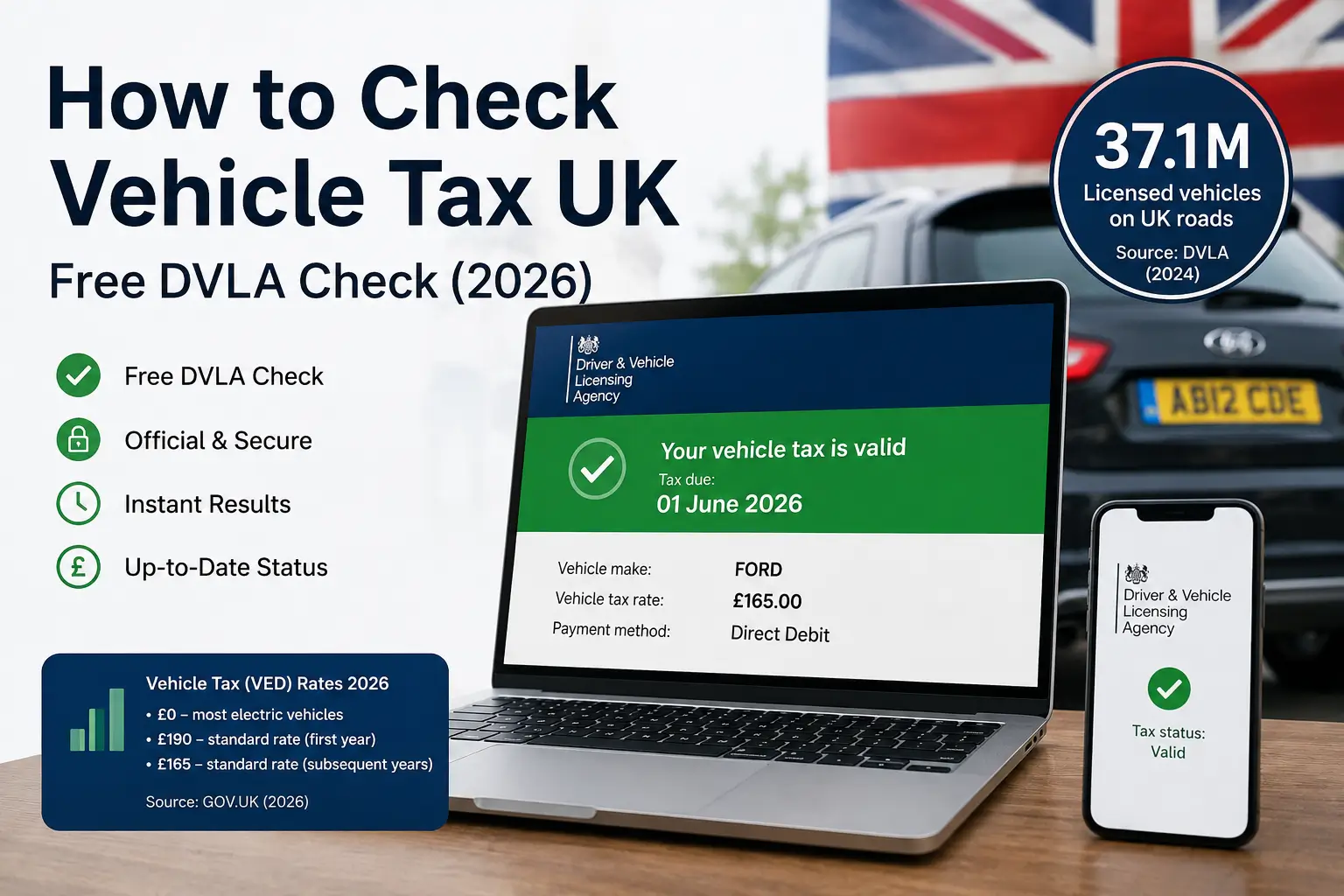
The only reliable way to check vehicle tax in the UK is the free GOV.UK vehicle enquiry service. Enter the registration number and confirm the make, and you’ll see whether the car is taxed, when the tax runs out, its CO2 band, and current MOT status — no account, no payment, no waiting.
That’s the short version. The longer version — why the result sometimes looks wrong, what changed for 2026, and what to actually do if a car comes back untaxed — is where most guides on this topic stop short. This one doesn’t.
Who this guide for:
This guide focuses on the official DVLA vehicle tax process. For other UK verification and compliance checks, see our homepage or get in touch via our Contact page if you have a specific check you’d like us to cover next.
What “Vehicle Tax” Actually Means?
Vehicle tax, road tax, car tax, and Vehicle Excise Duty (VED) are the same charge wearing four different names. VED is the official term. It’s an annual fee for keeping or using a vehicle on public roads, and the DVLA collects it on behalf of HM Treasury.
The “road tax” nickname is a leftover from a scheme scrapped back in 1937 — the money hasn’t been ring-fenced for road maintenance for nearly a century. It goes into general government spending, the same pot that funds schools and the NHS.
That distinction matters more than it sounds. People sometimes assume a well-maintained local road means their tax is “working” — it isn’t tied to that at all.
How to Check Vehicle Tax by Registration Number?
- Go to the official GOV.UK vehicle enquiry service. This is the DVLA’s own tool and the only source that pulls live, authoritative data — not a cached copy.
- Enter the registration number exactly as it appears on the number plate. Spaces don’t matter; accuracy does.
- Confirm the make. GOV.UK asks for this as a light verification step, mainly to stop the service being scraped in bulk by third parties. It’s a minor bit of friction, but it’s also the reason GOV.UK’s data tends to be cleaner than sites that skip this step.
- Read the result. You’ll get tax status, the date tax is due, MOT status and expiry, CO2 emissions band, and — if applicable — a SORN flag.
One thing that trips people up: you can’t run this check with a VIN (vehicle identification number). The registration number is the only accepted input, because VED is tied to the plate, not the chassis. If you’ve only got a VIN, you’ll need to find the current registration first — the V5C logbook has both.
Two common data-entry errors worth double-checking before you assume a result is wrong: the letter O typed instead of the number 0, and the letter I instead of the number 1. Registration plates don’t use either letter in ambiguous positions, but people transcribe them wrong constantly.
What Each Result Field Actually Tells You?
- Tax status — Taxed, Untaxed, or SORN. This is the headline answer most people are checking for.
- Tax due date — when the current cover runs out, not a renewal reminder date.
- MOT status and expiry — pulled from DVSA, shown alongside tax so you get the full legal-to-drive picture in one look.
- CO2 emissions band — the figure that determines the standard annual rate for post-2017 cars, and the entire first-year rate for new ones.
- SORN — Statutory Off Road Notification. If a vehicle is SORN’d, it’s legally allowed to sit untaxed, but only off public roads.
Vehicle Tax Rates for 2026 — What Actually Changed
VED rates rise every April in line with the Retail Price Index, and 2026 brought a few changes worth knowing before you check a number, not after.
| Vehicle type | 2025/26 rate | 2026/27 rate |
|---|---|---|
| Petrol, diesel, hybrid (standard rate, registered after April 2017) | £195 | £200 |
| Electric cars, first year | £10 | £10 |
| Electric cars, standard rate (from year two) | £195 | £200 |
| Highest first-year band (over 255 g/km CO2) | £5,490 | £5,690 |
| Historic vehicles (40+ years old) | £0 | £0 |
The change that catches the most people out isn’t the £5 rise on the standard rate — it’s that electric vehicles stopped being exempt from VED in April 2025 and now sit inside the same system as petrol and diesel cars. If you’re checking an EV’s tax status expecting a permanent £0, that assumption is out of date.
The Expensive Car Supplement — an extra annual charge for cars with an original list price above £40,000 — also shifted for EVs specifically. From April 2026, that threshold rises to £50,000 for electric cars, while it stays at £40,000 for everything else.
So two cars sitting next to each other with near-identical price tags can have different supplement liability purely based on fuel type.
Common Misconceptions That Cause False Alarms
“The result says untaxed, but I paid last week.” DVLA records can take up to five working days to update after a payment. If you’ve taxed a car recently and the check still shows untaxed, that’s the most likely explanation — not a payment failure.
“There’s a grace period if my tax lapses.” There isn’t. Unlike some other UK deadlines, VED has no buffer. The single exception is driving to a pre-booked MOT test, which is legally permitted even on an untaxed vehicle.
“Electric cars don’t need checking because they’re tax-exempt.” As covered above, that stopped being true from April 2025. Every EV registered before or after that date now needs the same check as any other car.
“A tax check tells me everything I need before buying a used car.” It tells you one specific legal fact: whether VED is currently paid. It says nothing about outstanding finance, previous write-off status, mileage discrepancies, or accident history. Treat it as one data point, not a full due-diligence check.
What to Do If a Vehicle Shows as Untaxed?
If the check confirms a vehicle genuinely isn’t taxed, here’s the actual process:
- To tax it yourself, use the GOV.UK service with one of three reference documents: the V11 reminder letter, the V5C registration certificate, or the green new keeper slip if you’ve just bought the car.
- Payment options include a single annual payment, Direct Debit (which renews automatically), or six-monthly/monthly instalments — the latter two carry a 5% surcharge.
- It’s illegal to drive an untaxed vehicle on a public road, with the narrow exception of a pre-booked MOT appointment. Untaxed and parked on a public road still counts as an offence unless SORN has been declared.
- To report someone else’s untaxed vehicle, DVLA accepts reports with the registration, make, model, colour, and location — but check the vehicle’s status yourself first, since it may simply be within that five-day update window.
SORN vs. Untaxed — Not the Same Thing
These two get confused constantly, and the distinction actually matters legally. A vehicle showing as “untaxed” with no SORN declared is not legally allowed on a public road at all. A vehicle with a SORN is also untaxed, but it’s declared off-road deliberately — sitting in a garage, a private driveway, or off-street storage — and that’s entirely legal.
The moment a SORN’d vehicle goes back on a public road, it needs to be taxed again first; SORN status doesn’t lapse into legal driving on its own.
Is Checking Vehicle Tax Still Worth It Before Buying in 2026?
Yes, but as a first step, not a last one. A tax check confirms the car is currently legal to drive and gives you a CO2 band that tells you what you’ll pay going forward — genuinely useful for budgeting, especially now that EV owners can no longer assume £0 running costs.
What it won’t tell you is whether the car has outstanding finance, was previously written off, or has had its mileage altered. For a private purchase in particular, pairing a free tax check with a paid vehicle history check closes that gap. The tax check answers “is this legal right now,” not “is this a good car to buy.”
FAQs
How do I check if a car is taxed using just the registration number?
Enter the registration number into the GOV.UK vehicle enquiry service and confirm the vehicle’s make when prompted. The result shows tax status, tax due date, and MOT status immediately, with no account or payment required.
Can I check vehicle tax using a VIN instead of a registration number?
No. The DVLA’s tax check only accepts the registration number, because VED is administered against the plate, not the chassis number. If you only have a VIN, look up the current registration on the V5C logbook first.
Why does the tax checker say my car is untaxed when I already paid?
This usually means the payment hasn’t processed through DVLA’s system yet. Records can take up to five working days to update after tax is paid, so a recent payment often won’t show immediately.
Are electric vehicles still exempt from vehicle tax in 2026?
No. The zero-rate exemption for electric vehicles ended in April 2025. From 2026, EVs pay £10 in their first year and then the standard rate, currently £200, from year two onward — the same structure as petrol and diesel cars.
Is there a grace period if my vehicle tax expires?
No. VED has no grace period. The only legal exception is driving to a pre-booked MOT test in an untaxed vehicle; otherwise, the vehicle must not be used or kept on a public road once tax lapses.
Is a basic vehicle tax check enough before buying a used car, or should I get a full history check?
A tax check confirms legal road status and CO2 band, but it doesn’t cover finance, write-off history, or mileage accuracy. For anything beyond checking your own car or a quick sanity check before a private sale, pair it with a full vehicle history check.
1 thought on “How to Check Vehicle Tax UK: Free DVLA Check (2026)”