Quick Answer:
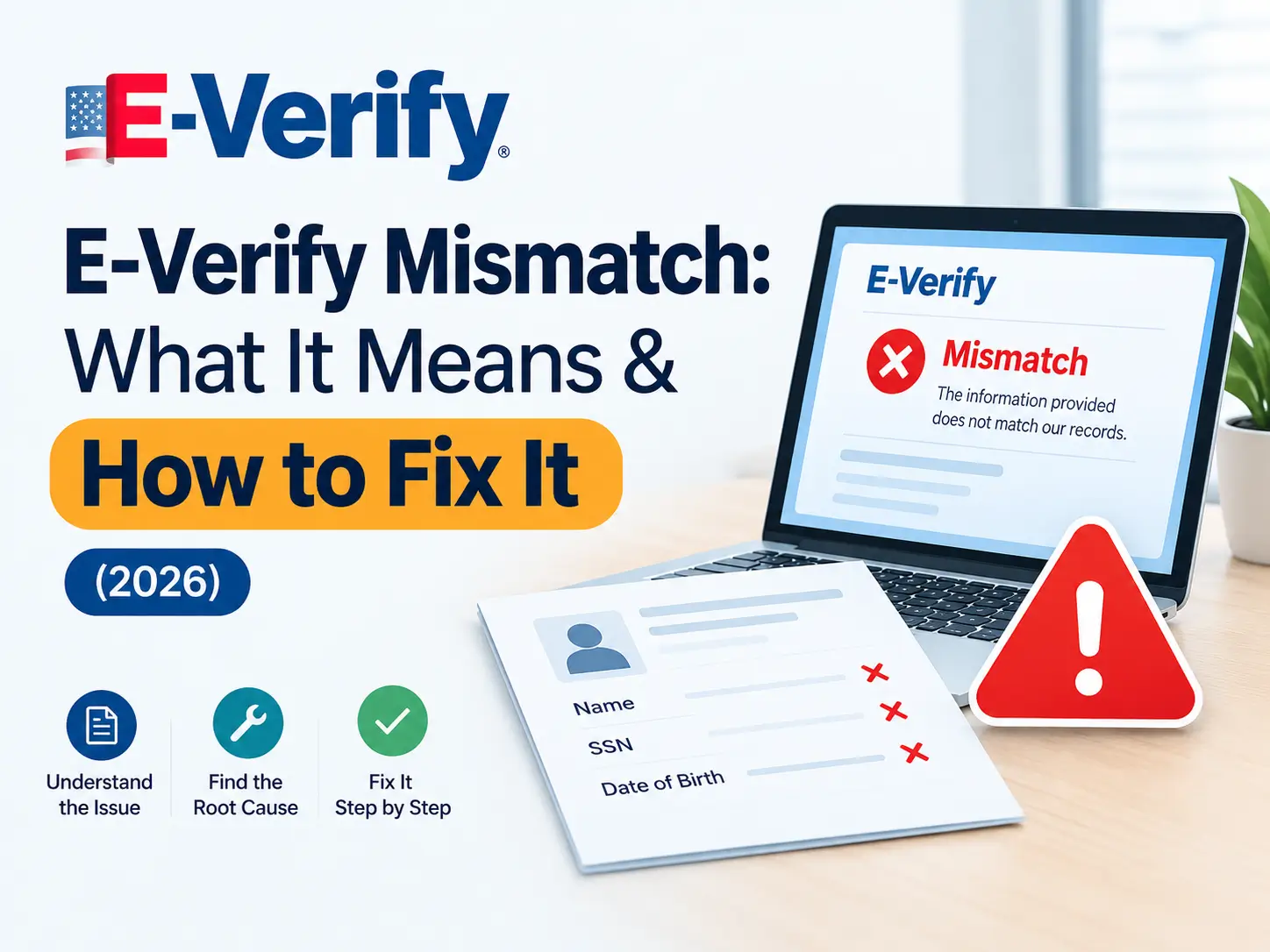
An E-Verify mismatch — officially called a Tentative Non-confirmation (TNC) — means the information on an employee’s Form I-9 doesn’t match Social Security Administration or Department of Homeland Security records. It doesn’t mean the employee is un-authorized to work.
The employee gets 10 federal working days to decide whether to contest it, and can keep working the entire time.That’s the core fact both employees and employers search for, and it’s also the fact most guides bury three paragraphs deep after a definition nobody asked for.
This one leads with it, then covers everything both sides actually need to do next — because the employer’s obligations and the employee’s obligations are genuinely different processes, and conflating them is where most confusion starts.
What Causes an E-Verify Mismatch?
E-Verify checks Form I-9 data against two separate government databases, and a mismatch can come from either one, or both at once:
- SSA mismatch — name, Social Security number, date of birth, or citizenship status doesn’t match Social Security Administration records. This is the most common mismatch type, and it’s frequently caused by something mundane: a recent legal name change from marriage or divorce that hasn’t been updated with SSA yet, a hyphen or suffix left off a name, or a simple data-entry typo.
- DHS mismatch — immigration status, Alien Number, Form I-94 number, or passport information doesn’t match Department of Homeland Security records.
- Dual mismatch — both agencies return a mismatch on the same case at the same time. This requires the employee to contact both SSA and DHS separately to resolve it.
- Photo mismatch — a distinct category that occurs when the photo E-Verify pulls doesn’t match the photo on the employee’s DHS- or State Department-issued document. Employers are not permitted to request or require documents specifically because they trigger photo matching; the employee always chooses which acceptable Form I-9 documents to present.
None of these results are a determination of work authorization. A mismatch is a data discrepancy flag, not a verdict — a distinction the employer is legally required to communicate, and one worth repeating because it’s the single most common source of employee panic.
The Timeline, Disambiguated!
This is where a lot of otherwise solid guides get sloppy, because there are two different clocks running, not one:
| Step | Who acts | Deadline |
|---|---|---|
| Employer notifies employee and issues the Further Action Notice (FAN) | Employer | As soon as possible, within 10 federal government working days of the mismatch result |
| Employee decides whether to contest | Employee | By the end of that same 10-day window |
| If contesting: employee contacts SSA and/or DHS | Employee | 8 federal government working days from the Referral Date Confirmation |
| If the employee contacts DHS but the case stalls | E-Verify system | Automatically marked “DHS No Show” after 10 federal working days without contact |
The 10-day window and the 8-day window aren’t the same clock — the 8-day period starts only after referral, which itself happens inside the original 10-day window.
Missing that distinction is exactly the kind of detail that makes an HR team miscalculate a deadline.
What Employees Need to Know?
If you’ve received a mismatch notice, three facts matter more than the rest of the process combined:
- You keep working. Your employer cannot fire you, suspend you, cut your hours, delay your start date, or withhold pay because of a pending mismatch. That protection lasts for the entire time your case is active — not just while you’re deciding, but while DHS or SSA is actively reviewing it too.
- You have to actually respond. Silence is treated as a decision not to contest. If you don’t tell your employer your decision by the end of the 10-day window, the case closes as a Final Nonconfirmation, and your employer can then legally end your employment.
- You choose which documents to present. No employer can require a specific document because it happens to trigger a photo check, and no employer can run E-Verify before you’ve accepted a job offer and completed Form I-9.
If your employer never gave you a Further Action Notice at all, that’s a compliance failure on their end — not a signal that you’re somehow already in trouble.
What Employers Need to Do?
Employers carry the compliance burden here, and it’s stricter than most day-to-day HR processes:
- Notify the employee privately and hand over the Further Action Notice — in English, plus a translated version if the employee needs one.
- Do not take adverse action — firing, suspending, delaying training, reducing hours, or withholding pay — at any point while the case is open, including during agency review.
- Refer the case promptly if the employee elects to contest, and provide the signed Referral Date Confirmation.
- Close every case, regardless of outcome. An open, unresolved E-Verify case sitting in the system is itself an audit risk, independent of what the mismatch was about.
- Never use E-Verify selectively. If you’re enrolled, every new hire goes through it — picking and choosing which employees to check is a violation on its own, separate from anything to do with mismatches.
The employer consequence for getting this wrong isn’t limited to the individual case — inconsistent or discriminatory E-Verify use can trigger a separate federal discrimination complaint through the Department of Justice’s Immigrant and Employee Rights Section, on top of whatever I-9 compliance exposure exists.
Common Misconceptions!
“A mismatch means I’m not authorized to work.” No. It means two databases don’t agree with each other on a data point — often something as minor as a married name not yet updated with SSA. Many mismatches resolve with no issue at all once the employee corrects the record with the relevant agency.
“I can’t work while my case is pending.” You can, and you’re legally entitled to. The only point at which employment protection ends is if the case becomes a Final Nonconfirmation — either because the mismatch genuinely couldn’t be resolved, or because the employee chose not to contest it.
“This is a temporary COVID-era policy that’s since expired, so the timelines might be different now.” Some older guides still reference pandemic-era extended timeframes for taking action on a mismatch. Those extensions ended years ago; the standard 10-day and 8-day windows described above are the current rule, not a temporary one.
What Happens After a Final Non-confirmation?
If the mismatch isn’t resolved — either because the employee didn’t contest it, didn’t respond within the window, or genuinely couldn’t clear it with SSA or DHS — E-Verify issues a Final Non-confirmation (FNC).
At that point, and only at that point, the employer can legally terminate employment without civil or criminal liability under the E-Verify program’s governing agreement. Before an FNC, ending employment over a pending mismatch is the adverse action the rules specifically prohibit.
Is E-Verify Still Relevant in 2026?
Yes, and arguably more so than a few years ago. E-Verify participation requirements have expanded through state-level mandates and federal contractor rules well beyond the voluntary federal baseline, and mismatch volume tends to track hiring volume — more on-boarding activity means more chances for a routine data mismatch to surface.
The program’s mechanics (SSA/DHS cross-checks, the 10-day and 8-day windows, photo matching for certain documents) have stayed structurally the same for years; what changes most often is state-level participation requirements, which is worth checking against current state law rather than assuming last year’s rules still apply.
FAQs
What does an E-Verify mismatch mean?
An E-Verify mismatch, formally called a Tentative Non-confirmation, means information from an employee’s Form I-9 doesn’t match Social Security Administration or Department of Homeland Security records.
It’s a data discrepancy, not a determination that the employee is un-authorized to work.
Can I still work while my E-Verify case shows a mismatch?
Yes. Federal rules require employers to let employees continue working during the entire mismatch resolution process, including while a referred case is under review by SSA or DHS.
Employers cannot suspend, delay, or reduce pay because of a pending mismatch.
How long do I have to resolve an E-Verify mismatch?
You generally have 10 federal government working days from when the mismatch result is issued to decide whether to contest it.
If you choose to contest, you then have 8 federal government working days from your Referral Date Confirmation to actually contact SSA and/or DHS.
What’s the difference between an SSA mismatch and a DHS mismatch?
An SSA mismatch means your name, Social Security number, date of birth, or citizenship status doesn’t match Social Security Administration records — often from a data entry error or an unreported name change.
A DHS mismatch involves immigration status, Alien Number, Form I-94 number, or passport data not matching Department of Homeland Security records. A dual mismatch means both agencies flagged the case at once.
Does an E-Verify mismatch mean I’ll be fired?
Not by itself. Termination is only legally permitted after a case becomes a Final Nonconfirmation — meaning the mismatch went unresolved or the employee chose not to contest it.
Firing someone during an active, unresolved mismatch is the specific adverse action the rules prohibit.
Is E-Verify still required for employers in 2026?
It depends on jurisdiction and contract type — federal contractors and employees in several states are required to use it, while it remains voluntary at the federal level for most other private employers.
Given how often state-level mandates shift, checking current state requirements is worth doing rather than relying on last year’s compliance status.