Quick Answer:
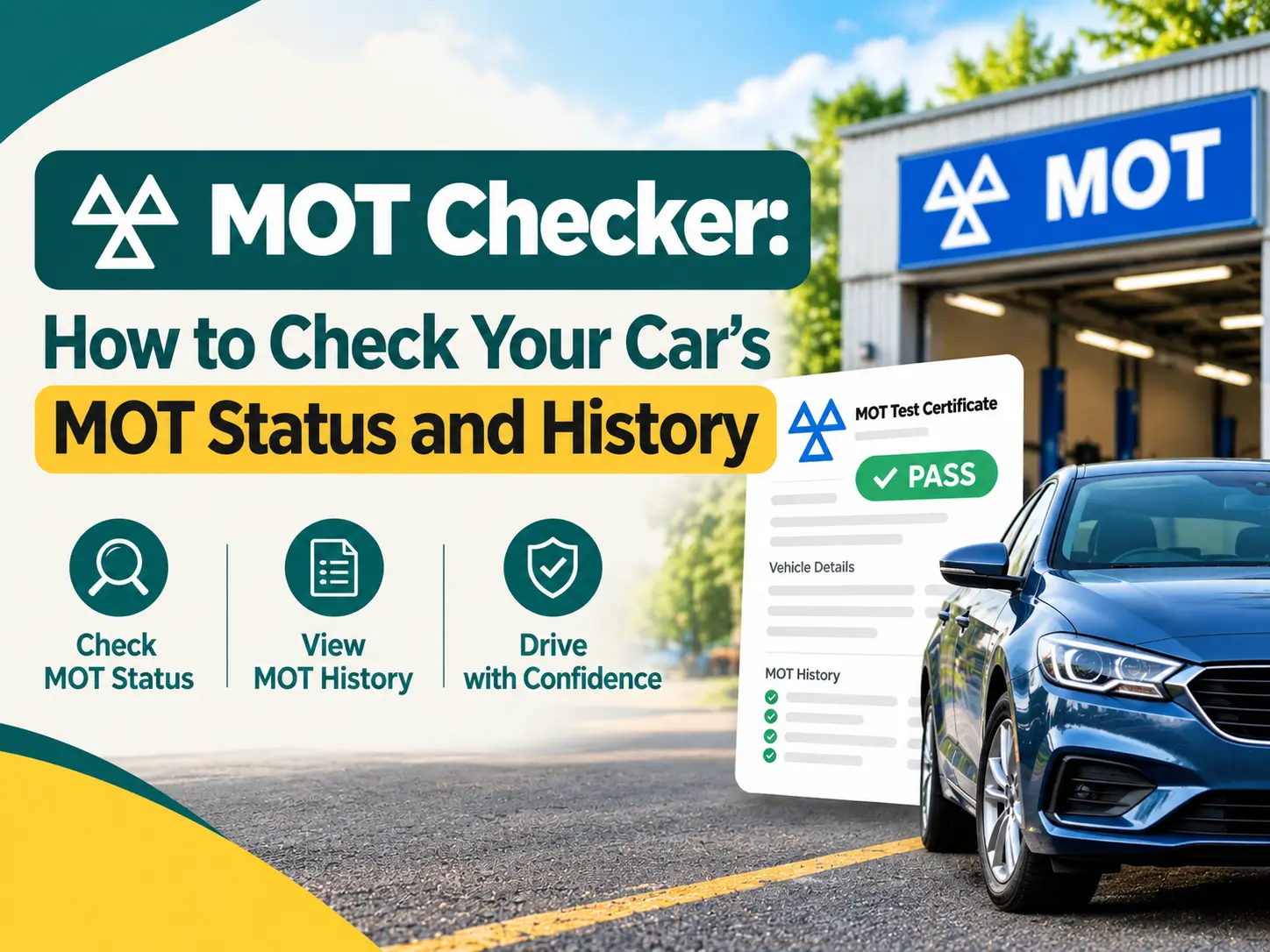
An MOT checker lets you look up any UK vehicle’s current MOT status and full test history free, using only its registration number, direct from official DVSA records. No account, no payment and no waiting on hold with a garage — the result appears in seconds, and it’s the same data a police ANPR camera or an insurer would see if they checked your car.
Most drivers only think about their MOT when a reminder letter turns up, but the letter isn’t guaranteed and it isn’t instant. Below is exactly how to check MOT status correctly, what the result actually tells you, and where drivers most often get the rules wrong — including the fine amounts and the Northern Ireland differences that a lot of MOT guides gloss over.
What Is an MOT Checker?
An MOT checker is a tool that queries the DVSA’s MOT test database and returns a vehicle’s current certificate status, expiry date and (optionally) its full test history. In Great Britain, the DVSA runs the scheme; in Northern Ireland, the equivalent body is the DVA, and its data sits in a separate system.
There are two distinct official lookups, and mixing them up is the single most common source of confusion online:
- MOT status check — tells you whether a vehicle currently has a valid MOT and when it expires. Nothing else.
- MOT history check — shows every test the vehicle has ever had since digital records began, including pass/fail results, mileage at each test, and any advisories or defects recorded.
Third-party MOT checker sites (including this guide) simply present the same DVSA data in a more readable format — they don’t hold separate records, and none of them can show you anything the DVSA database doesn’t already contain.
How to Check MOT Status Online?
- Go to the official GOV.UK MOT status checker at gov.uk/check-mot-status.
- Enter the vehicle’s registration number exactly as it appears on the number plate — no spaces are needed.
- Read the result. You’ll see whether the MOT is valid, the exact expiry date, and the vehicle’s make and colour as a match-confirmation.
For the fuller picture — previous tests, mileage readings, advisories and failure reasons — use the separate GOV.UK MOT history checker instead. Both tools are free, require no login, and pull from the same DVSA source, so there’s no “more accurate” version to pay for.
If you’re about to buy a used car, run the history check before you view the car, not after you’ve paid a deposit — a pattern of repeated advisories on the same component is one of the cheapest pieces of due diligence you can do.
What Information Does an MOT Checker Show?
A full MOT history check typically returns:
- Current MOT status and exact expiry date
- Every previous test date, going back to 2005 in Great Britain (2017 in Northern Ireland)
- Pass or fail result for each test
- The recorded mileage at each test
- Advisory notices (issues flagged but not serious enough to fail the car)
- The specific defects that caused any failure
- Whether the vehicle has an active recall registered against it
The mileage log is worth pausing on. Because it’s recorded independently by the test centre every year, comparing consecutive MOT mileage readings is one of the most reliable ways to spot a car that’s been clocked — a sudden drop, or a jump far above what the car’s age and history suggest, is a red flag worth asking the seller about directly.
Understanding MOT Defect Categories
Since May 2018, MOT results in Great Britain have used four defect categories instead of a simple pass/fail:
| Category | What it means | Does it fail the car? |
|---|---|---|
| Dangerous | An immediate risk to road safety | Yes — do not drive it, even home |
| Major | Could affect safety, the environment, or other road users | Yes |
| Minor | Doesn’t affect safety at the time of test but should be monitored | No, but recorded |
| Advisory | Worth watching and may need attention before the next test | No |
A vehicle can pass its MOT with minor issues and advisories still listed — these are worth reading in full, because they often show up again as major or dangerous defects at the next test if left unaddressed.
When Is Your First MOT Due?
New vehicles in Great Britain need their first MOT by the third anniversary of registration, then annually after that. In Northern Ireland, the first MOT isn’t due until the fourth anniversary — a genuine difference, not just a rounding error, and one that trips up a lot of drivers who’ve moved between the two.
Vehicles first registered more than 40 years ago are generally exempt from needing an MOT at all, provided no substantial changes have been made to the engine, axles, steering or braking system in the past 30 years.
The exemption date rolls forward every year, so it’s worth rechecking a classic car’s status annually rather than assuming last year’s answer still holds.
Wanna read check immigration status guide for your vehicle, Read our guide, check immigration status.
What Happens If You Drive Without a Valid MOT?
This is the area where online guides most often contradict each other, so here’s the straightforward version. Using a vehicle on a public road without a valid MOT, where one is required, is an offence under the Road Traffic Act 1988.
The maximum fine is £1,000. If the vehicle is found to have a dangerous defect, that rises to up to £2,500, along with three penalty points and the possibility of disqualification.
The bigger practical risk usually isn’t the fine — it’s your insurance. Most UK policies include a condition that the vehicle be maintained in a roadworthy, legally compliant state.
Drive with an expired MOT and have an accident, and your insurer has grounds to challenge or reduce a claim, potentially leaving you personally liable for damage, injury or repair costs that would otherwise have been covered.
The only journeys legally allowed on an expired MOT are a pre-booked journey directly to the MOT test itself, or to a garage for repairs already arranged to fix a previous MOT failure. Both exceptions require you to be able to show the appointment if asked.
Using an MOT Checker Before You Buy a Used Car
An MOT history check is one of the fastest pieces of due diligence available before buying privately, and it costs nothing. Beyond the obvious pass/fail record, look for:
- Recurring advisories on the same part across multiple tests, suggesting a fault the seller has been patching rather than fixing
- Mileage that doesn’t rise consistently year over year, which can indicate clocking or a replaced odometer
- A recent pass shortly before sale after several years of advisories on the same item, which sometimes means just enough work was done to pass the test, not to fix the underlying issue
None of this replaces a proper independent inspection or full vehicle history check for finance and write-off status, but it’s a genuinely useful first filter, and it takes under a minute.
FAQs
Is an MOT checker free to use?
Yes. Both the official GOV.UK MOT status checker and MOT history checker are completely free, with no account or sign-up required. Any site charging for a basic MOT status or history lookup is charging for something the DVSA already provides at no cost.
What’s the difference between an MOT status check and an MOT history check?
A status check only confirms whether the MOT is currently valid and when it expires. A history check goes further, listing every past test, its result, the mileage recorded, and any advisories or defects — useful for buying decisions, not just compliance.
How far back does MOT history go?
In Great Britain, records cover tests carried out since 2005. In Northern Ireland, records begin in 2017, because the DVA’s digital system started later than the DVSA’s.
Do I need my V5C logbook to check MOT status?
No. You only need the vehicle’s registration number. The V5C is required for things like taxing the vehicle or reporting a change of keeper, not for an MOT lookup.
Is a car with an MOT that expired yesterday still legal to drive?
No — there’s no grace period. The offence begins the day after expiry, regardless of how minor the delay is, with the only exception being a pre-booked journey to the MOT test itself.
My car’s MOT records aren’t showing up — why?
Usually one of a few reasons: the vehicle is under three years old and not yet due its first MOT, the test predates the 2005 (GB) or 2017 (NI) digital record cutoff, the registration was mistyped, or the vehicle is exempt as a vehicle over 40 years old. If none of these apply, contact the DVSA directly, since it could indicate a data-matching error.
Is checking MOT status still worth it in 2026 with more cars going electric?
Yes — electric vehicles still require an annual MOT from three years old in Great Britain, covering safety items like brakes, tyres, steering, lights and structural condition, even though there’s no exhaust emissions test to worry about. The check itself hasn’t become less relevant, just slightly shorter.